Bangalore to Kabini by Cab - Route, Safari and What Your Driver Handles
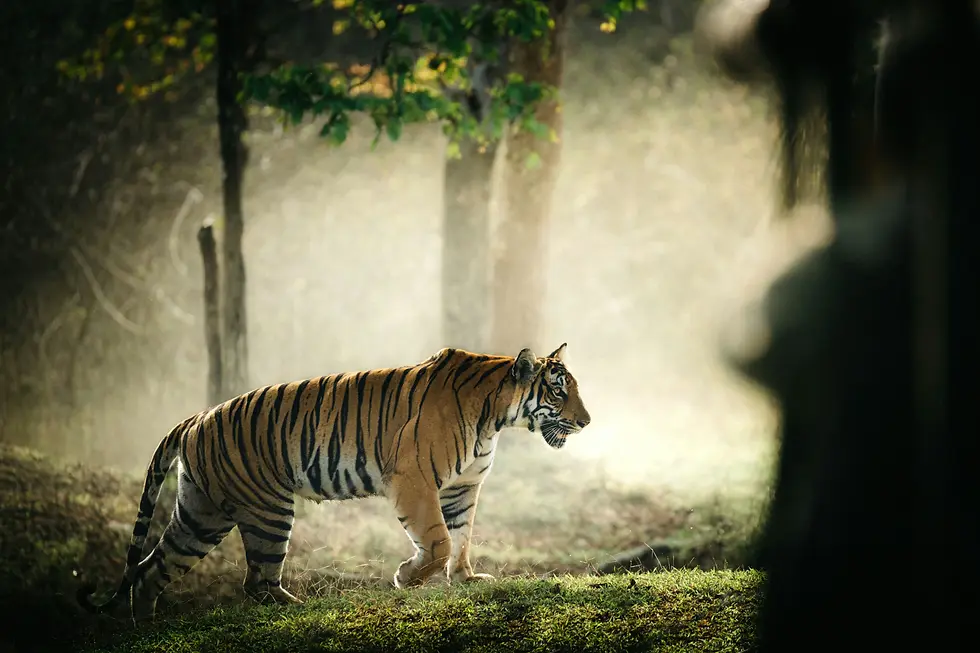
The pickup is at five-thirty, and Bangalore is still asleep. No traffic on the Outer Ring Road, no construction noise; just your driver loading the bags in the dark and the neighbour's dog watching from behind the gate. The Bangalore to Kabini drive is 220 kms by cab, most of it on the Mysore expressway — flat, fast, forgettable. It is the second half that changes.
Past Nanjangud, the four-lane highway shrinks to a two-lane state road and the landscape starts to thin. Paddy gives way to scrub, scrub to dry deciduous forest, and somewhere around Antharasanthe your phone signal drops to nothing. No Google Maps after this point; no calling ahead to confirm your kabini
safari slot. Your Komyut driver does not check his phone because there is nothing to check.
He has driven this stretch enough times to know the turns by memory, where the road curves before the forest checkpoint, where elephant herds cross between Nagarhole and the Kabini backwaters at dawn.
Nagarhole holds 149 tigers as of the 2022 census, and the backwaters along its southern edge are where photographer Shaaz Jung spent three years tracking Saya, the melanistic leopard whose images became a National Geographic documentary.
The forest gate locks at 6 PM sharp; the department does not hold permits for anyone running late. Everything on this route — your Bangalore departure time, the pace through Mysore, the fuel stop — is calibrated backwards from that gate. One driver handles the full Bangalore to Kabini run, and he is the same one who lines up at the safari gate at 5 AM the next morning.
The Kabini Route: Night Bans, Forest Gates and Why Your Driver Matters
The Nagarhole forest gate closes at six — not around six, not six-fifteen, six. The guards pull the barrier down and walk away, and it does not matter whether you are five minutes behind schedule or fifty — the result is the same. A night in H.D. Kote instead of the Kabini backwaters. Everything about the Kabini route works backwards from that deadline.
Most outstation drives from Bangalore are a straight shot: expressway, toll plaza, done. The Bangalore to Kabini drive by car is not. Three roads carry night bans, the forest gate runs on a hard clock, the afternoon kabini safari slot dictates your departure time from Bangalore, the check-post requires documents your driver must have ready, and your phone signal disappears 40 kms before you arrive. A Komyut driver who has run this route before knows how these pieces connect. A driver doing it for the first time discovers them one by one, usually too late.
The Supreme Court ban on NH766 through Bandipur runs 9 PM to 6 AM. The Hunsur forest road, another approach to Nagarhole, has no lights at all. And a thirty-minute delay at any point — a long breakfast stop in Mysore, a queue at the Nanjangud turn — cascades into a locked forest gate.
These closures shape the morning too. The afternoon kabini safari slot at Nagarhole opens at 3 PM. To reach the gate in time, departure from Bangalore is 5 to 5:30 AM, calibrated to a 10:30 AM resort arrival — set by the safari timing and the 6 PM lock, not by when anyone feels like waking up. Your Komyut driver, working from a route brief sent the day before, calculates every segment backwards from those two deadlines. The afternoon safari slot opens at three — miss the assembly window and the permit goes to the next name on the list.
The forest gate locks at six — arrive after that and you are spending the night in H.D. Kote, not at the Kabini backwaters. Everything else bends around them. Past Antharasanthe, the phone signal drops to nothing. No Google Maps for the final 40 kms of forest road. No calling ahead to confirm your safari booking.
No last-minute coordination with anyone. The driver navigates from memory — which turns come before the check-post, where the road surface breaks up after monsoon, which stretches narrow without warning. At the Nagarhole check-post itself, forest guards check the vehicle RC, a copy of the nagarhole safari booking confirmation, and a passenger count before issuing a transit pass.
Drivers unfamiliar with the process spend twenty to thirty minutes hunting for documents. A driver who has cleared this gate before has the folder ready and gets through in ten. What catches most people off guard is that the trip does not end when you arrive. Kabini is a two- to three-day stay, not a day run.
The Innova Crysta parks at the lodge, and the same driver who picked you up from the Bangalore Airport
at five in the morning handles the next day's 5 AM kabini jungle safari gate lineup, the afternoon boat ride on the Kabini backwaters, the transfer to the evening slot.
That continuity — one driver, one car, every leg of a multi-day trip where the phone signal is dead and the forest department runs on paper permits — is the difference between an oustation cab that flows and one where logistics are renegotiated every morning.
It does not always go perfectly. Some mornings the check-post queue runs long for reasons nobody explains, and a 6 AM kabini safari start slips to 6:20 with fewer minutes in the zone. The kabini safari booking portal on Nagarhole's website went offline in November 2025 after a park shutdown; it reopened in
February 2026 at half capacity, and permit allocations still shift without notice.
These are not problems a driver can fix. But a driver who has seen them before builds in the slack — an extra thirty minutes here, a printed backup permit there. Whether the booking system holds through the next season is a question the forest department has not answered.
What Your Komyut Driver Handles Between Bangalore and Kabini
A Bangalore to Kabini cab trip puts one person between you and every logistical detail on this route — your assigned Komyut driver, who arrives with a route brief already loaded, departure time reverse-calculated from your safari slot, and the Nagarhole check-post documents pre-filed in the glovebox.
The Bangalore to Kabini route involves tolls, a forest permit, a check-post that costs first-timers twenty minutes of fumbling, and a Kodava food tradition worth planning your resort meals around, and the driver handles or advises on all of it.
Toll Plazas, Permits and Forest Check-Post Entry
Two toll plazas sit between Bangalore and Mysore on the expressway, and the Komyut driver clears both via FASTag without the car slowing beyond lane speed — no cash exchange, no window interaction, just the scanner beep and the barrier lifting.
The Nagarhole check-post process covered earlier on this page takes the driver roughly 10 to 15 minutes when the trip folder with vehicle RC, resort booking confirmation, and passenger IDs is pre-filed, compared with the 20 to 30 minutes first-time visitors spend scrolling through phone screenshots while the queue builds behind them.
Private vehicles that enter the park on a transit pass cannot stop or step out inside the forest — guards at the exit gate check your time-stamp, and a Rs 1,000 fine applies if you exceed the one-hour drive-through window. Two-wheelers are prohibited on the forest road entirely, which is one reason the Kabini route requires a car and a driver who knows the gate rules before arriving.
Stops, Breaks and Where Your Driver Eats
The breakfast stop at Kamat Lokaruchi covered in the route section earlier is the driver's default — he pulls in, you eat, and the parking lot at 6:30 AM tells you that every outstation car headed south has the same idea. Your Komyut driver eats separately during the resort stay, typically at the H.D. Kote dhabas that line the last stretch of inhabited road before the forest, and driver batta — the daily meal and incidental allowance that covers outstation trips — means you do not need to arrange or think about the
driver's meals at any point during the stay.
And if your lodge happens to serve Kodava food — Evolve Back, Red Earth, and The Serai all do, to varying degrees — order the pandi curry before you order anything else. It is slow-cooked pork in kachampuli, that dark, reduced vinegar made from the fruit of the Garcinia gummi-gutta tree that grows across the Western Ghats but gets processed into this intensely sour cooking extract almost exclusively in Kodava kitchens. Ask for kadambuttu alongside, steamed rice dumplings that are dense, plain, and built to be torn apart and dragged through that gravy until the plate is clean. Or neeru dosa, which is nothing but rice batter thinned with water and poured onto a hot pan without oil — it comes out paper-thin and lacy, mild enough to let the kachampuli tartness in the pandi curry do all the work.
The Kodava kitchen does not do complicated — the dishes are spare, one or two ingredients done exactly right, which is why a plate of pandi curry with kadambuttu alongside works as a complete meal, and one you are more likely to order again on the second night than anything from the resort's continental buffet.
Coordinating Arrival With Safari and Resort Timing
The 5 AM departure, 10:30 AM arrival, 3 PM safari rhythm covered earlier on this page is the standard Komyut Kabini run, and the driver calibrates every stop and every check-post interaction to protect that resort timing rather than to optimise for speed.
If your kabini safari slot is morning rather than afternoon, the arithmetic shifts — departure moves to 3 or 4 AM, night batta applies, and the driver adjusts accordingly, all of which is settled in the route brief the evening before rather than negotiated at your front door at
dawn.
But check-post queue times are variable — ten minutes on a weekday can become thirty-five on a Saturday morning when a convoy of weekend tourists hits the Nagarhole gate simultaneously, and no amount of pre-filed paperwork fully insulates you from that wait.
The full kabini safari cost for a 2 to 3-day stay covers the vehicle, driver, batta, night batta for those pre-dawn safari-gate departures, and fuel — with expressway tolls, the forest permit, and applicable GST listed separately at actuals on the breakdown you receive before confirming. Unlike fixed kabini tour packages from Bangalore that bundle resort nights and safari permits into a single rate, the Komyut quote separates the car rental from the lodge and permit — you book your resort directly, and the transport pricing stands on its own.
For how Komyut's outstation car rental with driver pricing works across all routes, see the
full breakdown on the pillar page.
Kabini Safari Booking -- Permits, Zones and Gate Logistics
Kabini safari booking runs through the official Nagarhole Tiger Reserve portal , and the first thing that trips up every first-time visitor is that the portal asks you to book a "Nagarhole" safari — because as far as the forest department is concerned, there is no place called "Kabini."
The reserve covers 843.96 sq km across Mysuru and Kodagu districts, with a 643 sq km core area and a 200 sq km buffer zone, and "Kabini" is simply what everyone — resorts, travel sites, your colleague who went last year — calls the southern zone along the reservoir. What most visitors search for as a kabini national park safari is officially a Nagarhole booking, but the forest department uses the official name on every form, every ticket, and every page of the booking portal without ever clarifying that a nagarhole safari booking is your Kabini booking.
As of March 2026, the official portal shows safaris as open for booking again, after a suspension that ran over a hundred days following tiger-human conflict incidents in the surrounding districts, with safaris now running at 50% capacity under reduced vehicle numbers and shorter two-hour slots. If the portal goes offline again — and given its track record, that is a reasonable thing to plan for — coordinate through your resort or through Jungle Lodges and Resorts (JLR) directly for offline safari permit allocation.
How to Book Kabini Safari Online
When the portal is active, you go to nagaraholetigerreserve.com, register with your mobile number and a government-issued photo ID — Aadhaar works — select your date and time slot, choose between a jeep safari and a boat safari, pay online, and receive a confirmation with your gate assignment and reporting
time, which your Komyut driver prints and files alongside the vehicle RC and resort booking in the trip folder before departure.
For kabini safari online booking, plan 7 to 10 days ahead, because weekend slots in peak season between
October and February sell out within days of opening and the portal does not waitlist. The portal currently offers two-hour slots at all three gates, with four daily departures at Kakanakote and Nanachi (6 AM, 8:15 AM, 2:15 PM, and 4:30 PM) and two longer sessions at Veeranahosahalli, replacing the earlier three-hour
format after a June 2025 revision, and the slot you pick determines which gate your driver reports to on kabini safari morning.
But if the portal is offline or all slots are sold out, you can try booking directly at the kabini wildlife safari ticket counter at the gate — counter slots are limited and first-come-first-served, so arriving at least thirty
minutes before the slot time improves your chances, though on weekends the queue itself can be long enough that getting a spot is not guaranteed even if you show up early.
And when the portal is suspended entirely — as it was for over three months in 2025-2026 — the fallback is coordinating through your resort or through JLR, who manage their own vehicle fleet for in-house guests at the Kabini River Lodge and can sometimes arrange slots for non-resident visitors through their booking desk.
Safari Zones: Kabini, Nagarhole and Which to Pick
Three gates serve the park — Kakanakote gate — also called Dammanakatte — which is closest to most Kabini resorts and the default gate for anyone driving in from Bangalore via Mysore; Nanachi gate on the Kodagu side, convenient if you are approaching from Coorg; and Veeranahosahalli gate near Hunsur, which draws fewer vehicles and fewer tourists. A kabini forest safari through Zone A covers dense deciduous woodland with the highest tiger concentration in the reserve, and Zone B follows the Kabini backwaters, where elephant herds gather at dawn, gaur graze along the waterline, and the melanistic leopard — the kabini black panther known as Saya — is most reliably sighted along the reservoir edge.
The forest department canter is louder, slower, and holds around twenty passengers — but it covers both zones in a single run, which no private jeep booking can match. If you can only do one zone, pick Zone B for the Kabini backwaters — the elephants, gaur, and the melanistic leopard that draws photographers from three continents are all more reliably spotted along the water than in Zone A's dense canopy, and if you can swing two safaris across consecutive mornings, book one in each zone and let the forest show you why regulars come back for both.
Ticket Prices and Entry Fees (2026)
Pricing was revised in June 2025, with the Forest Department restructuring both tariffs and slot durations across all three safari centres.
Camera fees (revised June 2025):
DSLR cameras with lenses up to 200mm are free of charge, telephoto lenses between 200mm and 500mm carry a fee of Rs 1,000 plus 18% GST, and anything above 500mm costs Rs 1,500 plus 18% GST — a change
from the old flat-fee structure that used to charge for every camera regardless of lens size.
Prices marked are from draft data and require internal confirmation before publishing. Confirm current pricing on the official portal or with your resort before booking — rates may shift again after the reopening adjustments.
JLR operates its own private safaris at the Kabini River Lodge at rates that run higher than the Forest Department pricing — recent visitor reports from early 2026 put the JLR private jeep safari at approximately Rs 2,250 to Rs 3,500 per person depending on season and availability, with in-house guests getting priority. Third-party aggregator sites show bundled packages at around Rs 1,900 per person for Indian nationals, which typically rolls the vehicle, guide, and entry fee into one rate.
A full Forest Department jeep seats six to nine passengers, so a group of six booking all seats pays Rs 6,000 for what amounts to a private run — which, at Rs 1,000 a head, remains one of the most reasonable jeep safari ticket prices in any Indian tiger reserve. For kabini boat safari booking, the same portal applies — select "Boat Safari" instead of "Jeep Safari" when choosing your slot type.
Children below three years are not permitted on jeep safaris per forest department rules, children aged three to five have historically ridden free of charge, and the kabini river safari — what the portal lists as "Boat Safari" — has no formal age restriction but requires life jackets for children, which the department provides — though you should confirm current age policies on the portal before booking, as these rules were under review during the 2025-2026 reopening process and the official site does not currently state a
specific age cutoff.
Kabini Safari — Jeep Rides, Boat Rides and the Black Panther
The first thing you notice on a kabini forest safari is the sound — not the animals themselves, but the way the forest reacts to them. A langur alarm call carries differently through dense canopy than across open water, and that single difference is the clearest way to understand the two safari formats that run out of Nagarhole: the jeep ride through the forest interior, and the boat ride along the Kabini backwaters, where the reservoir opens the sky and the shoreline belongs to elephants.
Jeep Safari vs. Boat Safari: Which to Book
The kabini jeep safari runs two hours through deciduous forest interior, carrying six to nine passengers and one naturalist guide along roughly 25 kms of trail where the canopy closes overhead low enough that the 6 AM cold lingers well past sunrise, and the undergrowth on both sides is dense enough that you hear animals before you see them — a branch cracking under weight too heavy to be a deer, the staccato bark of a spotted deer that means a predator is close, the sudden silence that tells the naturalist to cut the engine and wait.
Zone A covers the densest section of the reserve, where tiger sightings are most likely, and Zone B follows the reservoir edge where the melanistic leopard that draws photographers from three continents is most reliably spotted.
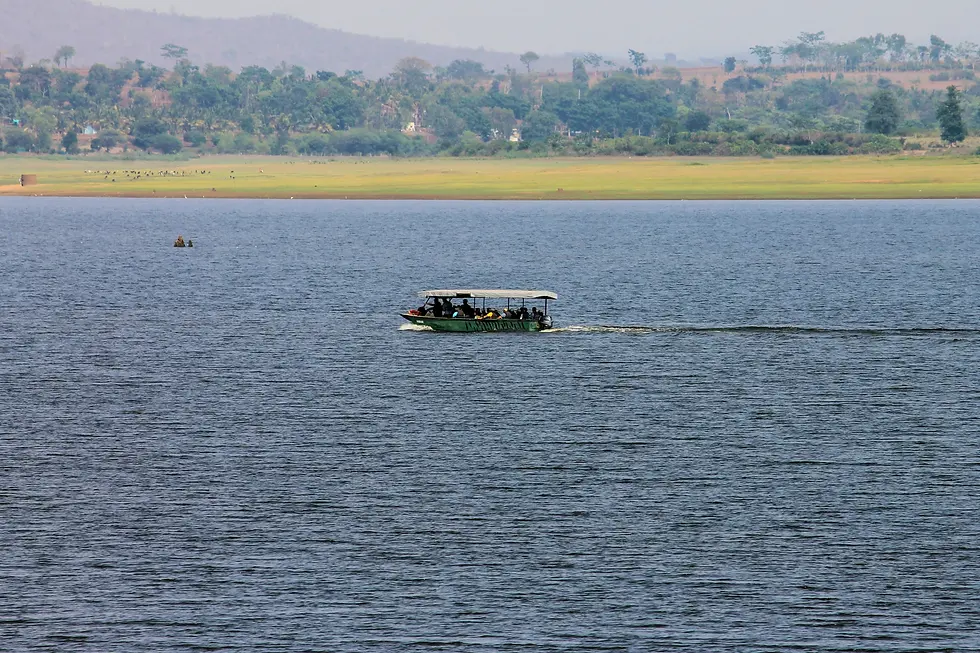
The kabini boat safari runs one and a half to two hours along the reservoir, and the shift in texture is immediate — the canopy opens to sky, the light hits the water at dawn, and what was dense and closed on the jeep trail becomes wide and still.
Elephant herds come down to the Kabini backwaters to drink at first light, kingfishers work the overhanging branches, and the park's nearly 300 documented bird species — enough to earn it a BirdLife International Important Bird Area designation — are overwhelmingly concentrated along this shoreline, which is why the kabini river safari is where birders spend their mornings rather than inside the forest where visibility drops to a few metres.
Whether you call it a kabini jungle safari or a kabini wildlife safari, the recommendation for a first visit is to book one jeep ride and one boat ride across consecutive days — a morning in the forest for predators, a morning on the water for elephants and birds — and let your Komyut driver stay at the resort for the full trip rather than coordinating transport from Mysore each day, because the consecutive 6 AM starts from the same base with the same departure logistics are what actually improve your odds of seeing what you
came for.
Spotting the Black Panther at Kabini
The kabini black panther is a melanistic leopard — a recessive genetic trait that produces excess melanin, turning the coat near-black while the rosette pattern remains visible under certain light. The most photographed individual is a male called Saya, first documented around 2015 and tracked over years of
fieldwork by wildlife photographer Shaaz Jung, whose National Geographic documentary The Real Black Panther chronicles Saya's rise from sub-adult challenger to the dominant male of Zone B, against Scarface, the alpha leopard who held the reservoir-edge territory before him.
Lodge estimates suggest that guests staying three consecutive days during peak season — morning safaris, same zone, same gate — have a reasonable chance of a black panther sighting, but no published source puts a reliable percentage on it, and the honest answer is that the forest does not adjust to your
schedule and single-safari visitors should not plan around a guaranteed encounter.
And this is where having the same Komyut driver parked at your resort for the full trip matters practically — the consecutive 6 AM starts that improve your odds need someone who has driven the resort-to-gate road enough times to know exactly how much lead time the morning departure requires, not a different
vehicle dispatched from Mysore each day.
Multi-day stays with a kabini national park safari booked in Zone B on consecutive mornings are the closest thing to a reliable strategy for spotting Saya, and even regulars will tell you it took them three or four visits before their first sighting.
Other Wildlife at Kabini: Elephants, Tigers, Gaur and Birds
March to May dries the forest floor and concentrates everything that needs water along the Kabini backwaters — what has been described as the highest density of wildlife anywhere in Asia during peak congregation. Elephant herds numbering thirty to fifty and sometimes more gather
along the reservoir edge where the water has receded. Gaur appear on nearly every safari run and occasionally hold up the trail for minutes at a time.
The sambar and chital that sustain the predator population become increasingly visible in the thinned-out summer understory. And the overall effect, across a three-day stay, is that the animals come to you rather than requiring the jeep to hunt through kilometres of forest to find them.
Tiger sighting data from Nagarhole suggests roughly one in every two to three safaris yields an encounter during peak months, better odds than most Indian reserves but not close to the consistency of Tadoba — and if tigers are your single priority and you only have one trip to plan, go to Tadoba, where open forest structure and sighting rates above seventy percent during peak season make it the most reliable tiger destination in the country.
But what Kabini gives you that Tadoba does not is the full range: cats, elephants, gaur, nearly 300 bird species under a BirdLife International Important Bird Area designation, and the chance of a melanistic leopard on the same morning run — all inside the UNESCO-designated Western Ghats World Heritage Site, where the Nilgiri Sub-Cluster that includes Nagarhole was inscribed in 2012.
The sighting report you are most likely to carry home from a three-day kabini national park safari is not any single animal but the accumulation — elephants at the waterline at dawn, gaur at the crossing, a leopard disappearing into dappled canopy.
Whether the monsoon shifts the peak by a fortnight or the forest department revises the slot structure again, that accumulation is what brings regulars back for a third and fourth visit, each time booking a longer stay and carrying fewer expectations about which specific animal they will see.
Best Time to Visit Kabini for Safari and Road Conditions
By late October the waterholes inside Nagarhole begin to shrink, and the animal trails that scattered across the forest during monsoon converge on the remaining pools. The best time to visit Kabini depends less on weather preferences and more on what you want to see, because each season changes both
the wildlife density on the safari trail and the Kabini road conditions on the drive in from Bangalore.
October to February: Peak Wildlife Season
October to February is the Kabini peak season — clear skies, daytime temperatures between twenty and twenty-eight degrees, and mornings in December and January that can drop below fifteen. The dry forest floor means the remaining waterholes become the only reliable water source for sambar, chital,
gaur, and the predators that follow them.
Waterhole sightings during this window are as concentrated as they get at any point in the year, which gives first-time visitors the highest probability of a multi-species sighting on a single morning run. And this is exactly why the Kabini safari season runs at full capacity from late October through early February, with the afternoon safari slots on weekends selling out three to four weeks before the date.
This is also when every resort between the highway and the park gate charges its highest rates and the two-lane road from H.D. Kote carries the most weekend traffic.
Based on Komyut's booking patterns, November and December are the months when Kabini demand peaks. A trip during peak season needs safari slots, resort, and cab confirmed at least three weeks out, preferably four. The bottleneck is not the vehicle but the limited forest department safari capacity that every
resort in the area draws from.
March to May: Summer Heat and Last-Chance Sightings
March to May is the Kabini summer safari window — temperatures that push past thirty-five degrees by mid-morning and a forest floor baked dry enough to crack. The wildlife concentrates at whatever water remains, making this the strongest stretch for elephant herds massing at the Kabini backwaters and for
big cats near the last active waterholes.
The Kabini Reservoir drops through March and April as water is released for downstream irrigation, exposing shoreline that was underwater all winter. Elephant herds numbering thirty to fifty gather along this receding edge at dawn, and the morning boat safari puts you at water level watching them drink
within camera range — a different scale of encounter from what the closed-canopy forest interior during peak season offers.
Book an AC vehicle for a summer Kabini trip — an Innova Crysta or Innova Hycross — because the difference between working AC and none becomes apparent around noon when you are covering the last hundred kms of state highway and forest road between Nanjangud and the park gate with the windows sealed
against thirty-seven-degree heat.
And something almost nobody's itinerary includes. As the reservoir recedes, the Mastigudi temple surfaces from the water — a village shrine in Balle Shibira submerged when the Kabini dam was completed in
1974, fifteen years after construction began in 1959, its carved stone idols of Lord Ganesha and Goddess Mastamma still intact after five decades underwater. The village that surrounded it
was swallowed entirely when the reservoir filled, and the lake that covers the site is still locally called Mastigudi lake.
Every summer, when the idols resurface, naturalists and safari drivers from the Kabini resorts along with
members of the forest department, regardless of faith, gather on the exposed banks for a puja seeking safe passage through the coming safari season. It appears on no tourist map and no resort includes it in their safari briefing, but your Komyut driver — if he has done this route through April before — will know where to point when you pass the reservoir on the way to the gate.
June to September: Monsoon Season
Nagarhole does not shut down for monsoon the way Kanha, Corbett, and Ranthambore do — the park technically stays open year-round, and the Kabini monsoon months from June through September still see some safari operations. But forest roads become unpredictable with landslips, waterlogging, and
visibility that drops to twenty metres inside the tree line, and enough individual runs get cancelled that treating this stretch as a practical monsoon closure for planning purposes is the safer approach.
The November 2025 suspension covered earlier on this page — three months of halted safaris following tiger-human conflict — was unrelated to monsoon. But it is a reminder that closures can happen outside the regular wet season, and this is worth factoring in when deciding how far ahead to commit to dates. If your Kabini trip dates hit a closure or cancellation window, Komyut adjusts your cab booking to alternate dates.
The forest department's safari portal at nagaraholetigerreserve.com remains the most reliable check on current operational status, and refreshing it a week before departure is worth the thirty seconds regardless of which season you plan to travel in.
Kabini Tour Packages From Bangalore -- What a Chauffeur-Driven Trip Costs
A two-day Bangalore to Kabini trip breaks into three cost layers — the cab, the safari fees, and the resort stay — and each one bills separately, which is worth knowing before you start estimating the total kabini safari cost from numbers spread across three different websites.
The safari fees are covered in the booking section above, and the resort is between you and the property, so what follows here is the cab cost: what a chauffeur-driven Bangalore to Kabini trip costs for the vehicle, the Komyut driver, and the drive.
A two-day Kabini round trip from Bangalore covers roughly 440 to 460 kms of actual driving, but Komyut's outstation pricing runs on a 300 km minimum per day, which means a two-day trip gets billed at 600 kms regardless of what the odometer reads.
On top of the per km rate, there is batta — the daily meal and rest allowance for the driver — added for each calendar day of the trip. And since most Kabini departures are around 5 AM to make the afternoon safari slot, the early pickup triggers a one-time night batta, a separate charge for any outstation start time before 6 AM.
Worked example — Innova Crysta, 2-day Kabini trip (as of March 2026):
600 km × Rs 24/km = Rs 14,400 + Rs 400 batta × 2 days (Rs 800) + Rs 400 night batta for the 5 AM pickup = Rs 15,600 before tolls, parking, permit, and GST.
The Innova Crysta is the most booked vehicle for this route, with enough boot space for camera bags and binoculars and enough cabin room that five hours on the highway does not compress your knees or your patience.
For other vehicle classes and their per km rates, from a Dzire at Rs 14/km to a Mercedes E-Class
at Rs 90/km, see the optional here. Your Kabini quote covers the vehicle, driver, batta, and night batta for the 5 AM pickup — those are fixed before you confirm.
What sits outside the quote and gets charged at actuals: the expressway toll plazas on the Bangalore-Mysore stretch, roughly Rs 350 each way for a car or SUV which comes to about Rs 700 for the round trip, any forest permit or vehicle entry fee at the park gate, resort parking if applicable, and GST at the applicable rate, all listed as separate line items on the cost breakdown you receive before confirming your booking.
For the full outstation pricing model, the 300 km minimum explained in detail, and every vehicle class with its per km rate and batta amount.
Visit our outstation page. Share your Kabini trip dates and group size with us, and you get back a line-by-line cost breakdown with every charge listed separately alongside your assigned driver's name, typically within two hours of your enquiry.
Chauffeur-driven cab or taxi from Bangalore to Kabini takes 4.5 to 5.5 hours,
door to door. Alternatively, KSRTC bus or train to Mysore in about 3 hours,
then a combination of local bus to H.D. Kote and a hired vehicle to the park
gate, which adds another 4 to 7 hours depending on connections. A cab is the
only option that takes you from your Bangalore address to the resort gate in a
single vehicle without changing at Mysore.
About 220 km via NH275 through Mysore, Nanjangud, and H.D. Kote. Roughly 120 km of expressway and 100 km of two-lane state highway and forest road. Google Maps shows 3.5 to 4 hours, but actual drive time runs closer to 4.5 to 5.5 hours once you add expressway tolls, a breakfast stop, and the forest gate check-post where every vehicle is logged before entering the reserve.
Possible but tight. The drive is 4.5 to 5.5 hours each way, which leaves roughly 3 to 4 hours at Kabini. That is enough time for one boat safari on the backwaters but not enough for a jeep safari inside the park, since jeep slots run for about two hours and the logistics of reaching the gate eat into the window. A two-day, one-night trip is the practical minimum if you want a proper safari experience.
Sedans like the Dzire and Honda City, SUVs like the Innova Crysta and Innova Hycross, and larger vehicles up to a Mercedes E-Class. The Innova Crysta is the most booked for this route — enough cabin room for a family of four with safari gear, and enough ground clearance for the forest road past H.D. Kote.
For summer trips when temperatures push past thirty-five degrees, specify which model you want when you book. Full list and per-km rates on the https://www.komyut.io/chauffeur-vehicle-classes-india.
Kempegowda International Airport is about 40 km north of Bangalore city, which adds roughly an hour to the drive. Total time from airport to resort: 6 to
6.5 hours. Komyut offers Airport Transfers where the same driver who takes you to Kabini meets you at arrivals, so there is no separate city cab and no vehicle change between the airport and the resort.
Visit https://www.nagaraholetigerreserve.com/en/. Select your date, slot — morning or afternoon — and safari type, either jeep or boat. Pay online. Carry a printed copy of the confirmation and your original government-issued photo ID to the gate. Weekend slots during peak season from October through February sell out within days of opening, so book as early as the portal allows.
Yes — your Komyut driver parks at the resort and stays for the full two to three-day Kabini trip. The same driver handles the 5 AM safari gate lineup, afternoon boat ride transfers on the backwaters, and any resort-to-gate runs in between. This matters because past Antharasanthe there is no reliable phone signal, the forest department runs on printed permits, and having a driver who cleared the check-post on day one rather than a fresh dispatch from Mysore saves time at the gate each morning.
The quote covers the vehicle, driver, per-km charges based on a 300 km daily minimum, batta — the driver's daily meal allowance — night batta for the pre-6 AM pickup, and fuel.
Expressway tolls, any forest entry fee, resort parking, and GST are listed separately at actuals on the cost breakdown you receive before confirming. This is the cab layer only — safari fees and your resort stay are booked and paid separately. For per-km rates by vehicle class, see
Yes. Komyut handles airport pickup at Kempegowda International Airport and the same driver continues to your Kabini resort. At the Nagarhole forest check-post, your passport works as the ID document — the driver handles the entry paperwork the same way he would for an Indian guest with an Aadhaar card.
The Karnataka Forest Department charges a separate entry rate for foreign nationals on safari, so check current pricing on https://www.nagaraholetigerreserve.com/en/ before booking your slots.
Yes. Komyut provides a chauffeur-driven cab from any Bangalore address or Kempegowda International Airport to your Kabini resort. Same driver, same vehicle for the full trip — pickup, drive, wait at the resort while you are on safari, and drive back. Share your travel dates and group size via the contact form to get a detailed quote with your assigned driver's name.
October to February for peak wildlife density and pleasant weather. March to May for big cat sightings near the remaining waterholes and large elephant herds along the receding backwaters.
The park stays open during the June to September monsoon months, but forest roads become unpredictable and enough individual safari runs get cancelled that treating monsoon as an off-season for planning purposes is the safer approach. Weekdays see fewer vehicles on every run, which makes March to May weekdays the quietest window with the strongest sighting probability.
Kabini's Zone B along the backwaters is one of the most reliable locations in India for spotting a melanistic leopard. The most photographed individual, a male called Saya, has been documented extensively by wildlife photographer Shaaz Jung.
Multi-day trips with consecutive morning safaris improve the odds significantly, though sightings are never guaranteed.
Frequently Asked Questions — Bangalore to Kabini by Cab


All Our Services
From flexible hourly rentals to curated outstation journeys and punctual airport transfers, discover a suite of premium chauffeur services designed for your ultimate comfort and safety.